Sodium 1-pentanesulfonate
Product name: Sodium 1-pentanesulfonate
Synonym(s): Pentane-1-sulfonic acid sodium salt
CAS Number: 22767-49-3
Introduction
| Grade:98% | |
| Product name | Sodium 1-pentanesulfonate |
| CAS No. | 22767-49-3 |
| Test Items | Specifications |
| Appearance | White crystalline powder |
| Assay | ≥98.0% |
| Loss on drying | ≤2.0% |
| Grade: Chromatographic Grade | |
| Product name | Sodium 1-pentanesulfonate |
| CAS No. | 22767-49-3 |
| Test Items | Specifications |
| Appearance | White crystalline powder |
| Assay | ≥99.0% |
| pH | 5.5-7.5 |
| Loss on drying | ≤2.0% |
| UV Transmittance | 200nm, ≥70% |
| 220nm, ≥90% | |
| 250nm, ≥98% | |
Sodium Pentanesulfonate (CAS 22767-49-3) :
- Chemical Name: Sodium pentanesulfonate
- CAS Number: 22767-49-3
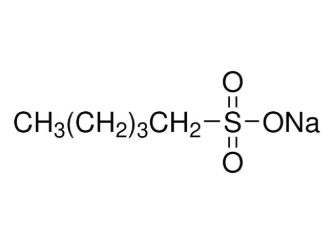
- Molecular Formula: C₅H₁₁O₃SNa (anhydrous), or C₅H₁₃NaO₃S (monohydrate commonly supplied)
- Molecular Weight: 174.19 g/mol (anhydrous), 176.21 g/mol (monohydrate)
- Appearance: White to off-white crystalline powder, odorless
- Melting Point: ≥300 °C (decomposes)
- Solubility: Freely soluble in water, forming a clear, colorless solution; solubility >500 g/L at 25 °C
- UV Cutoff: ~210 nm, suitable for HPLC detection with UV detection systems
- Purity: Typically ≥98% (HPLC or titration grade); high-purity grades (≥99%) available for chromatographic applications
- Hygroscopicity: Slightly hygroscopic, store in sealed containers
- Stability: Stable under normal temperature and pressure; avoid strong oxidizing agents
- Applications:
- Widely used as an ion-pair reagent in reversed-phase HPLC (RP-HPLC) for the separation of cationic compounds such as amines, peptides, and antibiotics.
- Acts as an anionic surfactant in formulation development with low toxicity and high water solubility.
- Compatible with mass spectrometry (MS) when used in low concentrations.
- Storage: Store in a cool, dry, well-ventilated area. Recommended to keep at 2–8 °C for long-term stability. Protect from moisture and light.
- Safety Information:
- Generally considered low toxicity; however, avoid inhalation, skin contact, and ingestion.
- Use appropriate personal protective equipment (PPE) such as gloves, goggles, and lab coat during handling.
- No significant acute hazards reported, but follow standard laboratory safety practices.